

Cost Confidence Should Arrive Before the Obituary
Major projects rarely fail without warning.
The warning signs are usually visible long before the final cost overrun, programme delay or uncomfortable board meeting. Scope remains unclear. Assumptions are left untested. Design development moves more slowly than expected. Risk allowances become placeholders. Market conditions change, but the estimate does not.
Yet organisations often wait until the project is already in trouble before asking whether the cost estimate can be trusted.
By that point, cost confidence has arrived too late. It has become part of the project obituary rather than a tool for preventing failure.
Cost confidence should not be something discovered during a post-project review. It should be built deliberately, tested regularly and communicated honestly throughout the project lifecycle.
What Does Cost Confidence Actually Mean?
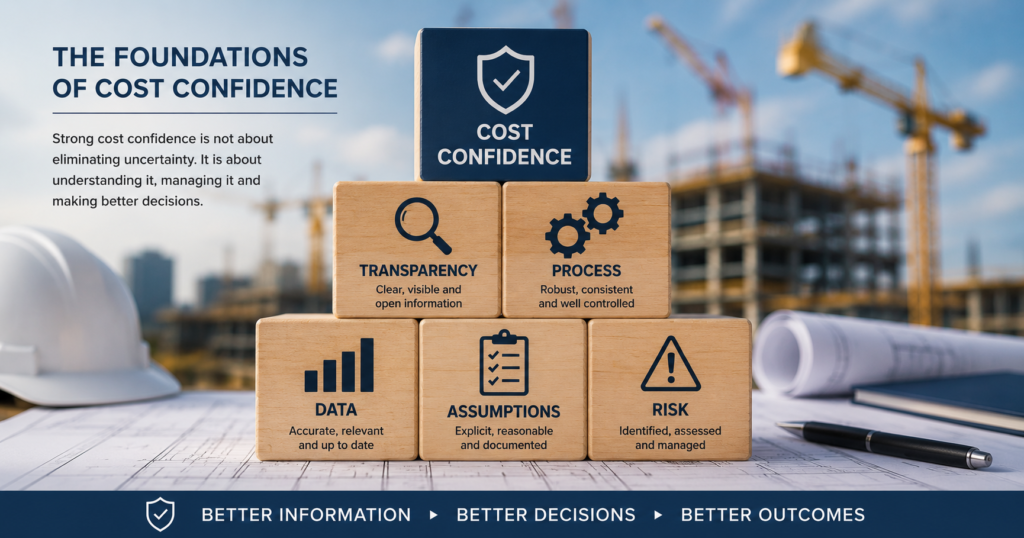
Cost confidence does not mean pretending that a project cost is certain.
In the early stages of a project, uncertainty is unavoidable. The scope may still be developing, the design may be incomplete and several major decisions may not yet have been made. A responsible estimate should reflect that position rather than hide it.
Cost confidence means understanding:
- what is included in the estimate;
- what information the estimate is based on;
- which assumptions have been made;
- what remains uncertain;
- how risks and opportunities have been treated;
- how reliable the underlying data is;
- and what level of decision the estimate can reasonably support.
An estimate can contain a wide range and still provide confidence, provided the range is properly explained.
Equally, a single precise figure can provide very little confidence if its scope, assumptions and evidence are unclear.
Confidence is not created by the number of decimal places in the cost report. It comes from the quality and transparency of the estimating process.
Why Projects Discover Cost Problems Too Late
Many project teams focus heavily on producing the headline cost but spend far less time testing the conditions behind it.
The estimate may be reviewed for arithmetic accuracy while more important questions remain unanswered:
- Is the scope complete enough for the estimate classification being claimed?
- Are quantities linked to the latest design?
- Have exclusions been understood by the decision-makers?
- Are interfaces between packages clearly allocated?
- Does the programme reflect realistic construction sequencing?
- Are current market conditions represented?
- Has risk been assessed or merely covered by a standard percentage?
When these questions are not addressed, the estimate can create an impression of control without providing real cost confidence.
The problem may remain hidden while the project passes through early approvals. It becomes visible later, when design information improves, tenders are returned or construction begins.
At that stage, the project has not suddenly become more expensive. The organisation has simply gained better information about a cost that was never fully understood.
Cost Confidence Is a Governance Issue
Cost estimating is often treated as a technical exercise carried out by the estimating or commercial team.
It is more than that.
A cost estimate influences whether a project is approved, how funding is allocated, which option is selected and what commitments are made to clients, investors, regulators and the public.
That makes cost confidence a project governance issue.
Senior decision-makers do not need to examine every rate, quantity or spreadsheet formula. They do, however, need clear answers to several basic questions:
- What do we currently know?
- What do we not yet know?
- What has been assumed?
- How could those assumptions affect the outturn cost?
- What decisions are required before greater confidence can be achieved?
A strong governance process does not ask the estimator to remove uncertainty. It asks the project team to explain it and manage it.
This distinction matters. Pressure to provide a more comfortable number does not improve cost confidence. It simply makes uncertainty less visible.
The Basis of Estimate Is the Starting Point
A credible Basis of Estimate is one of the most important foundations of cost confidence.
It should explain how the estimate was prepared and provide enough information for another competent person to understand the logic behind it.
A good Basis of Estimate should cover:
- project scope and estimate boundaries;
- design information used;
- estimate methodology;
- pricing sources and base dates;
- productivity and construction assumptions;
- programme and phasing assumptions;
- exclusions and qualifications;
- treatment of inflation, escalation and foreign exchange;
- risk and contingency methodology;
- allowances for temporary works, logistics and interfaces;
- and the expected accuracy or estimate classification.
Without this information, the estimate may be little more than a number supported by institutional memory.
That approach can survive while the people who created the estimate remain involved. It becomes much less reliable when the project changes hands, assumptions are forgotten or the original spreadsheet is reused for a different purpose.
The Basis of Estimate provides continuity. It allows the project to understand not only what the number was, but why it was considered reasonable at the time.
Estimate Maturity Must Match Project Maturity
One of the most common causes of misplaced cost confidence is the failure to distinguish between different levels of estimate maturity.
An early estimate based on limited information should not be presented with the same confidence as a detailed estimate supported by developed design and market-tested prices.
This does not make the early estimate useless. Early estimates are essential for option selection, business cases and investment planning. However, they must be used for the decisions they were designed to support.
False confidence appears when:
- an early benchmark becomes a fixed budget;
- a broad cost range becomes a single public commitment;
- an assumed quantity becomes a contractual expectation;
- or an estimate prepared for option comparison is later treated as a delivery forecast.
As the project develops, the estimate should be updated to reflect better scope definition, revised quantities, new risks and current market information.
Confidence should grow because the evidence has improved, not because the reporting range has been artificially narrowed.
Contingency Cannot Repair an Unclear Scope
Contingency has an important role in cost estimating, but it is frequently asked to solve problems it was never designed to address.
A percentage added to the base estimate cannot compensate for:
- missing scope;
- unresolved design decisions;
- poorly defined interfaces;
- unrealistic programme assumptions;
- outdated rates;
- or incomplete procurement planning.
These are not simply cost risks. They are signs that parts of the project remain undefined.
A risk-based contingency assessment can help demonstrate how identified uncertainty may affect the project cost. However, contingency should not become a general storage area for every unanswered question.
Where major scope or design decisions remain open, they should be reported clearly. Decision-makers should be able to see which costs are based on defined requirements and which depend on future choices.
Otherwise, contingency creates the appearance of protection while the underlying cost exposure remains poorly understood.
Independent Cost Assurance Should Happen Early
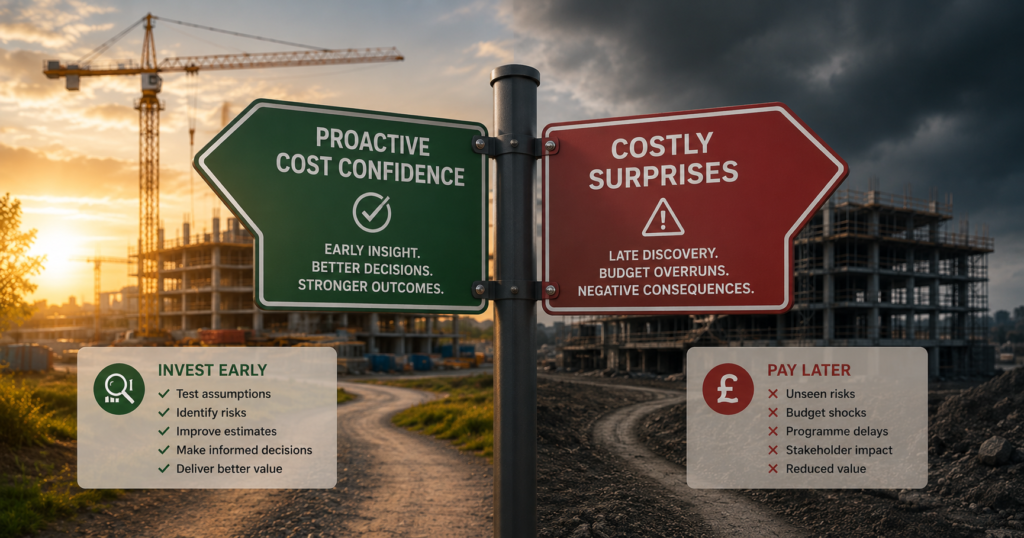
Independent cost assurance is often introduced when confidence has already been damaged.
A review is commissioned after a major increase, an unexpected tender return or a funding challenge. The reviewer is then asked to explain what went wrong.
This can be useful, but it is also expensive and reactive.
The greater value comes from assurance carried out before major commitments are made.
Early cost assurance can test:
- estimate structure and completeness;
- scope alignment;
- benchmark selection;
- quantity development;
- pricing methodology;
- risk treatment;
- market assumptions;
- and consistency between cost, design and programme.
It can also identify optimism bias, duplicated allowances, missing interfaces and unsupported adjustments before they become embedded in the approved budget.
Independent assurance should not be treated as an attempt to produce a lower number. Its purpose is to establish whether the estimate is reasonable, traceable and suitable for the decision being taken.
Sometimes that process will identify savings. Sometimes it will reveal additional cost. In both cases, the value lies in improving the quality of the decision.
Confidence Should Be Communicated, Not Implied
Cost reports often provide pages of figures but very little explanation of confidence.
A decision-maker may see a total estimate, contingency amount and percentage movement from the previous period, without understanding what caused the change or how reliable the current position is.
Effective cost reporting should communicate:
- the maturity of the estimate;
- key changes since the previous version;
- major assumptions and exclusions;
- principal cost risks and opportunities;
- areas of weak or incomplete information;
- and the actions required to improve confidence.
This does not require unnecessarily technical language.
Plain statements are often more useful:
The current estimate is suitable for option comparison but not for setting a delivery budget.
The civil engineering quantities are based on developed information, while the systems costs remain benchmark-based.
The current allowance assumes access will be available during normal working hours. A restricted access strategy could materially increase the cost.
Statements like these allow decision-makers to understand the conditions attached to the number.
The Right Time to Challenge the Estimate
The most effective time to challenge an estimate is before the project becomes committed to it.
That means asking difficult questions during option development, business-case preparation, design reviews and stage-gate approvals.
It means resisting the temptation to convert every early estimate into a promise.
It also means recognising that an increase in the estimate is not always evidence of poor estimating. It may reflect scope growth, design development, market movement or the removal of an unrealistic assumption.
The purpose of cost management is not to keep the reported number unchanged at all costs. It is to provide an honest view of the likely financial outcome and support better project decisions.
Build Cost Confidence Before the Project Needs Rescuing
Projects do not need perfect information before decisions can be made. They need a clear understanding of the information available, the uncertainty that remains and the consequences of being wrong.
Cost confidence is built through disciplined scope definition, transparent assumptions, appropriate estimating methods, structured risk analysis, reliable data and regular independent challenge.
None of these activities is particularly dramatic.
That may be why they receive less attention than the eventual cost overrun.
But the quiet work carried out before approval is usually far more valuable than the investigation commissioned after failure.
By the time the project obituary is being written, everyone can explain why the original estimate was unreliable.
The better question is why nobody demanded that explanation before approving it.