
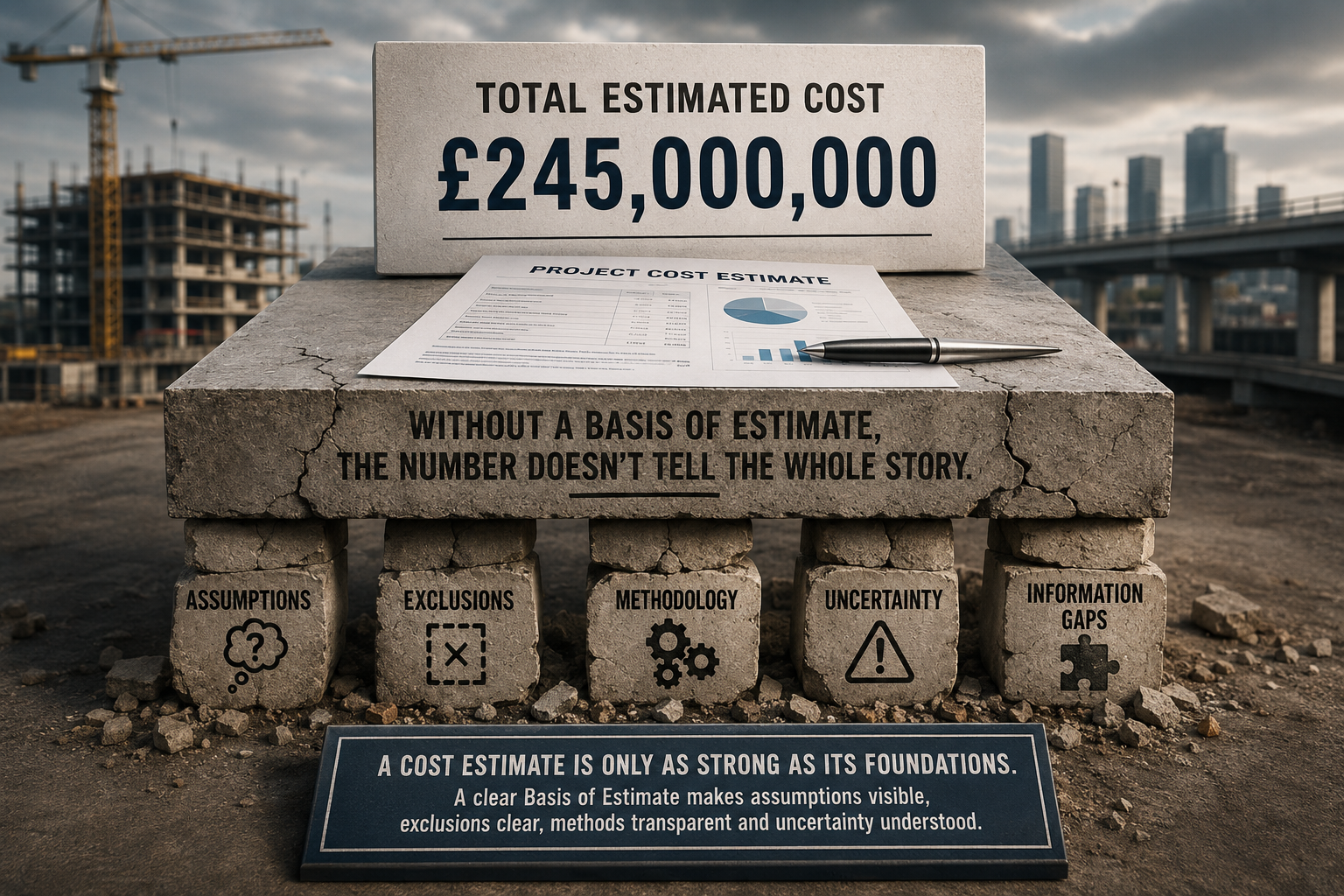
The Basis of Estimate Is Not Administrative Decoration
A cost estimate is not just a number.
It is the result of decisions, assumptions, exclusions, quantities, rates, risks, programme information and professional judgement. Yet on many infrastructure projects, the document that should explain all of this — the Basis of Estimate, or BoE — is treated as an administrative attachment.
It is written at the end of the estimating process, often in a hurry, so that a governance box can be ticked.
That approach misses the point.
A good Basis of Estimate is not decoration. It is the document that explains what the estimate means, how it was produced and how much confidence decision-makers should place in it.
Without it, even a technically competent cost estimate can quickly become misleading.
What Is a Basis of Estimate?
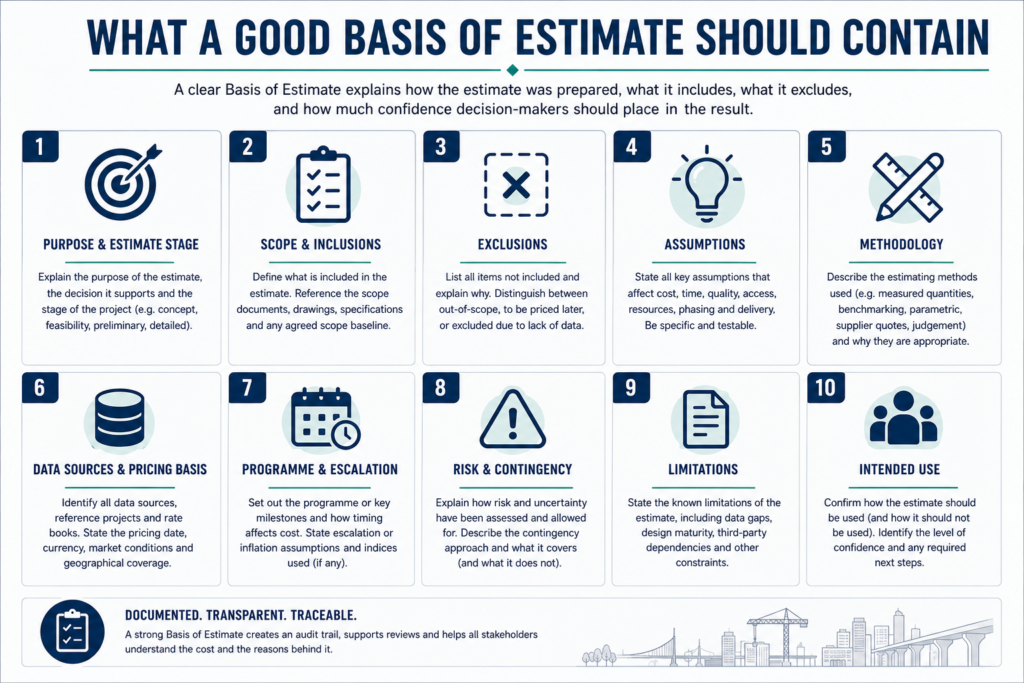
A Basis of Estimate is the structured record of how a cost estimate has been prepared.
It should explain:
- the purpose of the estimate;
- the project scope included;
- the scope excluded;
- the design information available;
- the estimating methodology used;
- the source and date of cost data;
- the assumptions made;
- the allowances included;
- how risk and uncertainty have been treated;
- the programme and pricing dates;
- the estimate’s level of maturity;
- any important limitations or qualifications.
The BoE provides the context needed to understand the headline cost.
For example, a project estimate of £200 million may appear clear and precise. But that number means very little unless the reader also knows whether it is based on concept drawings, measured quantities, benchmark rates, contractor quotations or broad assumptions.
The number alone does not tell the story.
The Basis of Estimate does.
Why the Estimate Cannot Stand Alone
Cost estimates are regularly copied into business cases, board papers, funding submissions, presentations and financial models.
During that process, much of the original context can disappear.
A range becomes a single number. An early estimate becomes a budget commitment. A provisional assumption becomes an approved scope item. An estimate prepared for option comparison is later treated as though it were suitable for procurement.
This is how estimates are often misunderstood.
The problem is not always that the original estimate was wrong. The problem is that it has been separated from the information needed to interpret it correctly.
The Basis of Estimate creates a clear link between the cost and the conditions under which that cost was developed.
It allows decision-makers to understand not only how much the project might cost, but also:
- what has been priced;
- what has not been priced;
- what remains uncertain;
- what information was unavailable;
- what could cause the estimate to change.
That is essential for sound project governance.
A Basis of Estimate Protects the Project
The BoE is sometimes seen as something that protects the estimator.
It does, but that is not its main purpose.
Its real purpose is to protect the project from false certainty.
Infrastructure projects are developed through stages. At the beginning, there may be limited design information, an uncertain programme and several unresolved interfaces. As the project develops, the scope becomes clearer and the estimate should become more detailed.
A good Basis of Estimate makes this level of maturity visible.
It prevents an early-stage estimate from being presented as more accurate than the available information allows. It also helps future teams understand why previous decisions were made.
This is particularly important when projects run for several years and the people involved change.
Without a clear BoE, future estimators may have to reverse-engineer the original estimate. They may not know:
- which quantities were measured;
- which rates were benchmarked;
- whether inflation was included;
- which design standards were assumed;
- whether access constraints were considered;
- how temporary works were treated;
- which risks were included in the contingency.
This leads to wasted effort, inconsistent comparisons and avoidable disputes.
Assumptions Are Part of the Estimate
Assumptions are often placed near the end of the Basis of Estimate as though they are minor notes.
They are not minor.
On an immature project, assumptions can shape a large part of the estimated cost.
An assumption about working hours can affect labour productivity. An assumption about site access can affect logistics, plant and temporary works. An assumption about possession availability can transform the cost of a railway scheme. An assumption about ground conditions can significantly change the expected cost of foundations.
Assumptions should therefore be:
- specific;
- measurable where possible;
- linked to the relevant cost item;
- reviewed by the appropriate project discipline;
- updated as new information becomes available.
Statements such as “normal ground conditions assumed” or “adequate access available” are usually too vague.
What counts as normal? What type of access is required? What happens if the assumption proves incorrect?
A good BoE does not hide uncertainty behind general wording. It makes the uncertainty visible and manageable.
Exclusions Must Be Clear
Exclusions are equally important.
A cost estimate may exclude land acquisition, client costs, utility diversions, inflation, tax, third-party fees, operational disruption or specific packages that will be developed later.
These exclusions may be entirely reasonable.
The danger begins when they are not clearly communicated.
A figure can appear more affordable simply because important elements sit outside the estimate. When the excluded items are later added, the resulting increase may be described as cost growth, even though the original number never included the full scope.
A strong Basis of Estimate should identify exclusions in plain language.
It should also distinguish between:
- work that is genuinely outside the project scope;
- work expected to be funded elsewhere;
- work that is required but has not yet been estimated;
- costs excluded because reliable information is not available.
These are not the same thing, and decision-makers should understand the difference.
The BoE Should Explain the Estimating Method
Not every part of an estimate will be developed using the same method.
Some elements may be based on measured quantities and current market rates. Others may rely on historical project data, parametric models, supplier quotations or professional judgement.
The Basis of Estimate should explain which methods have been used and where.
This helps reviewers judge whether the approach is proportionate to the project stage.
For example, an analogous estimate may be suitable during early option development. It may not be suitable for approving a detailed construction budget without further development.
Similarly, a supplier quotation may appear more reliable than a benchmark rate, but its value depends on the scope, commercial conditions, validity period and level of competition behind it.
Naming the estimating method is not enough. The BoE should explain why that method was appropriate and identify its limitations.
Risk and Contingency Need an Explanation
Contingency is not a substitute for incomplete scope definition.
Nor should it be presented as a percentage added to the estimate without explanation.
The Basis of Estimate should describe how uncertainty has been considered and how any risk allowance has been calculated.
This may involve:
- identified risk events;
- quantitative risk analysis;
- expected-value calculations;
- range estimating;
- optimism bias;
- deterministic allowances;
- specific provisions for unresolved scope.
The method should be suitable for the project stage and the intended decision.
The BoE should also state what the risk allowance covers and, just as importantly, what it does not cover.
Otherwise, the same uncertainty may be included twice or omitted entirely.
For example, the base estimate may already contain conservative productivity rates, additional quantities and provisional allowances. Adding a broad contingency percentage on top may duplicate some of the same uncertainty.
Transparent documentation allows this to be reviewed.
A Good BoE Supports Estimate Reviews
An estimate review should not be limited to checking formulas, rates and arithmetic.
Reviewers need to understand the logic behind the estimate.
The Basis of Estimate provides the structure for that review.
It allows the project team to challenge questions such as:
- Is the scope aligned with the latest design?
- Are the quantities consistent with the drawings?
- Are the rates suitable for the location and delivery model?
- Has the programme been reflected in the cost?
- Are the assumptions realistic?
- Are the exclusions understood?
- Has risk been treated consistently?
- Is the estimate suitable for the decision being requested?
Without a proper BoE, estimate reviews can become superficial. The spreadsheet may be checked while the reasoning behind it remains untested.
A mathematically correct estimate can still be strategically wrong.
The Basis of Estimate Must Be Developed Early
One of the most common mistakes is to write the BoE after the estimate has been completed.
By then, important reasoning may already have been forgotten. Assumptions may be difficult to trace, and different contributors may have worked to different interpretations of the scope.
The Basis of Estimate should begin at the start of the estimating process.
An initial version can record:
- the estimate’s purpose;
- the information available;
- the agreed scope boundaries;
- the proposed methodology;
- required inputs;
- key assumptions;
- responsibilities;
- known information gaps.
It can then be updated as the estimate develops.
This turns the BoE into a working project-control document rather than a final administrative exercise.
It also encourages earlier conversations between estimating, design, planning, risk, procurement, commercial and project management teams.
What Does a Good Basis of Estimate Look Like?
A good BoE does not need to be unnecessarily long.
It needs to be clear, structured and proportionate to the estimate.
It should allow an informed reader who was not involved in preparing the estimate to understand:
- what the estimate is for;
- what information it is based on;
- what is included and excluded;
- how the costs were calculated;
- which assumptions have been made;
- how uncertainty has been addressed;
- how the estimate should and should not be used.
The document should be consistent with the cost model, programme, risk register and project scope.
It should not contradict the spreadsheet it is meant to explain.
Most importantly, it should be written in clear language. The purpose is not to make the estimating process look complicated. It is to make the estimate understandable.
The Number Is Only the Beginning
Project teams often ask estimators to “just provide the number”.
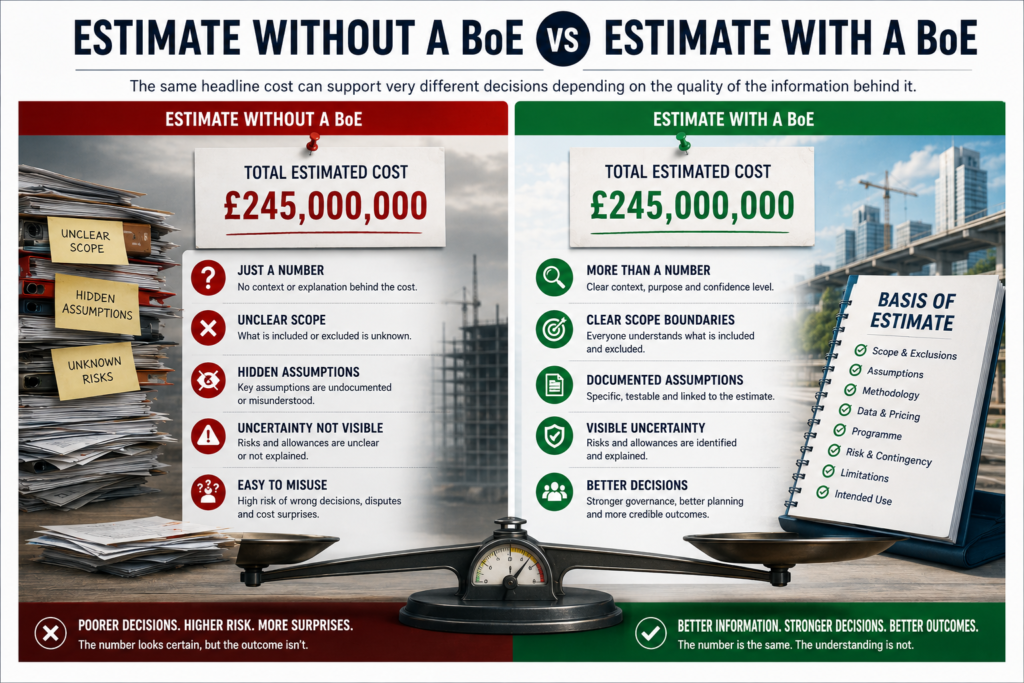
But a number without context is easy to misuse.
The Basis of Estimate gives the cost estimate meaning. It creates an audit trail, supports governance, improves estimate reviews and helps future teams understand how the project’s cost position has developed.
It also makes uncertainty visible before uncertainty becomes a surprise.
The BoE is therefore not an optional appendix and it is not administrative decoration.
It is part of the estimate itself.
When the Basis of Estimate is weak, the headline number may look confident while resting on unclear scope, undocumented assumptions and misunderstood risk.
When the Basis of Estimate is strong, decision-makers can see both the cost and the reasoning behind it.
That is what a credible estimate should provide.