
Contingency: The Magic Word Everyone Misuses
Contingency is one of the most commonly used words in cost estimating.
It is also one of the least consistently understood.
Ask five people on the same project what ‘contingency’ means, and you may receive five different answers. One person will call it a risk allowance. Another will describe it as money for unknowns. Someone else will treat it as management reserve. The project sponsor may see it as available budget, while the delivery team may quietly consider it a convenient fund for anything that was forgotten.
This is how a legitimate cost allowance becomes a magic number.
A percentage is added to the estimate. The total looks more reassuring. Everyone moves on.
But contingency is not magic, and it is not a substitute for understanding uncertainty.
Used properly, contingency helps decision-makers understand the possible financial consequences of identified uncertainty. Used badly, it hides weak scope definition, incomplete design, missing information and unresolved decisions behind a neat percentage.
What Is Contingency in Cost Estimating?
Contingency is an allowance included within a cost estimate to cover the financial effect of uncertainty associated with the defined project scope.
The words that define project scope matter.
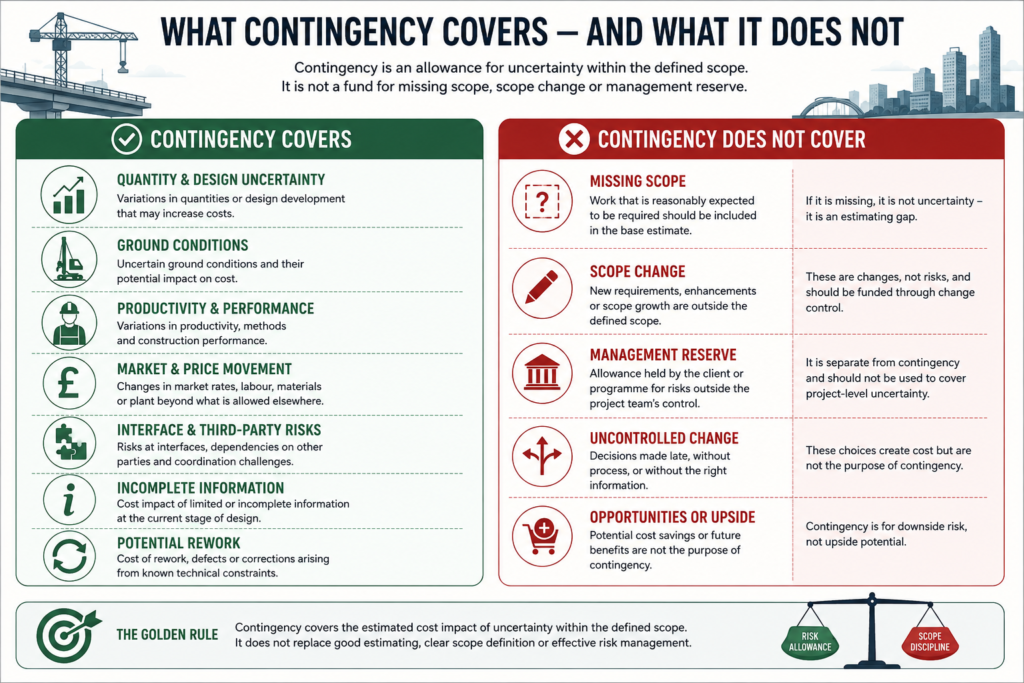
Contingency is not intended to pay for an entirely new station, an additional bridge, a major change in specification or a late decision to redesign the project. Those are scope changes, not uncertainty within the existing scope.
A good contingency allowance should relate to specific areas of uncertainty, such as:
- quantities that may increase as the design develops;
- uncertain ground conditions;
- productivity variation;
- market price movement not covered elsewhere;
- incomplete information at the current design stage;
- interface risks between contractors or work packages;
- potential rework arising from known technical constraints.
The allowance should reflect what is known about the project, what remains uncertain and how that uncertainty could affect cost.
It should not simply reflect what percentage the organisation has always used.
The Traditional Percentage Problem
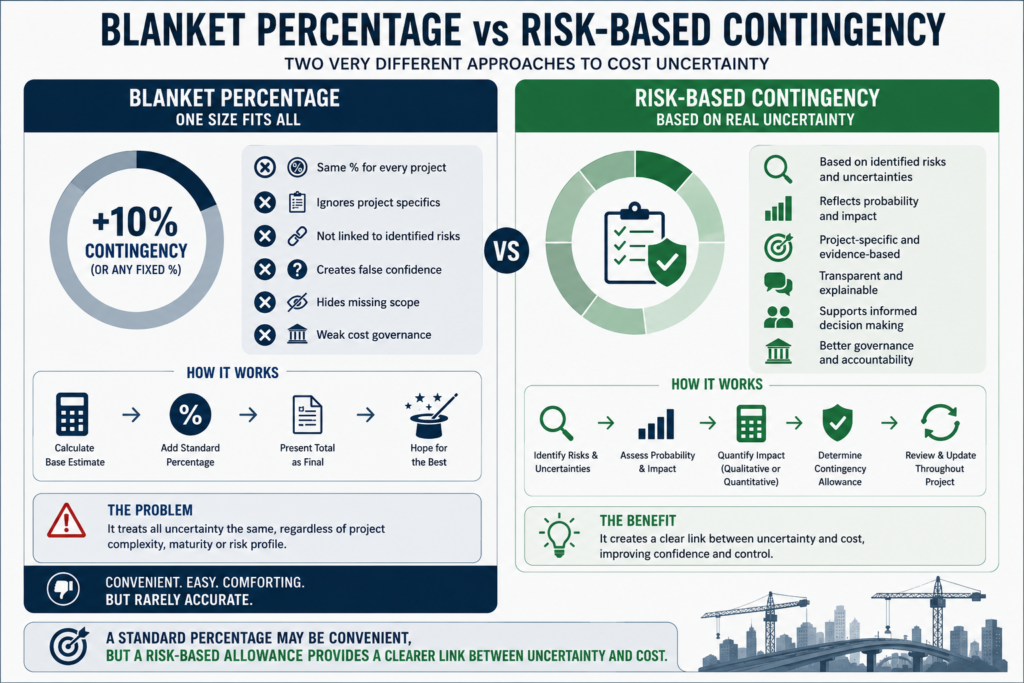
Many estimates still receive contingency through a familiar process:
- Calculate the base estimate.
- Add 10 per cent.
- Call it contingency.
- Present the total as though something scientific has happened.
A standard percentage may be useful as an early sense check, but it is not automatically a reliable assessment of project uncertainty.
Two projects with the same base cost can have completely different risk profiles.
One may have a mature design, completed surveys, clear interfaces and recent market prices. The other may have limited site information, an incomplete scope, uncertain planning requirements and several unresolved technical options.
Applying the same contingency percentage to both projects suggests that their uncertainty is identical. It clearly is not.
The percentage approach can also create false confidence. A figure such as 12.5 per cent looks precise, but precision is not the same as accuracy. Without a clear explanation of how the allowance was developed, the extra decimal place is largely decorative.
Contingency Is Not a Home for Missing Scope
One of the most damaging uses of contingency is as a storage area for items not properly included in the base estimate.
Missing drainage? Put it in contingency.
No allowance for temporary works? Contingency will cover it.
Unclear utility diversions? That sounds uncertain, so let contingency handle it.
This approach confuses incomplete estimating with risk analysis.
Where work is reasonably expected to be required, it should normally be included in the base estimate. The fact that its quantity, design, or delivery method is not yet fully developed does not mean that the entire item should be relegated to contingency.
For example, if a project clearly requires site access roads, the expected cost of those roads should be included in the base estimate. Contingency may cover uncertainty in their final length, construction depth or ground treatment. It should not be used to pretend that the roads do not exist until someone remembers them later.
A weak base estimate with a large contingency allowance is still weak.
It is simply wearing a larger coat.
Contingency Is Not Management Reserve
Contingency and management reserve are often treated as interchangeable, but they serve different purposes.
Contingency is generally associated with uncertainty within the approved and defined scope. It should be visible within the estimate and supported by an assessment of risk and uncertainty.
Management reserve is normally held separately by the client or programme leadership for matters outside the control of an individual project team, or for changes that cannot reasonably be assigned to the project estimate at that stage.
The exact terminology varies across organisations, so the Basis of Estimate must explain what each allowance includes.
Without that explanation, the project may contain several overlapping pots of money, all apparently intended to protect against the same uncertainty. Alternatively, everyone may assume that someone else is holding the necessary allowance.
Both situations tend to become expensive.
Contingency Should Reflect Estimated Maturity
Contingencies should normally change as the project develops.
At an early stage, the design may be limited, quantities may be based on high-level assumptions, and delivery arrangements may be unclear. The level of uncertainty is therefore likely to be significant.
As surveys are completed, options are selected, designs are developed,d and market information improves, some uncertainty should be reduced. The estimate should become better defined, and the contingency requirement should be reassessed.
This does not mean contingency must always reduce in a perfectly straight line.
New information can reveal risks that were not visible earlier. A ground investigation may identify poor soil. Design development may expose a difficult interface. Market testing may show that previous rates were too optimistic.
However, contingency should not remain fixed simply because changing it would create an awkward conversation.
If the design is becoming more mature but the contingency remains untouched, the project should ask why. Either the risks have not been reviewed, or the allowance was never properly connected to them in the first place.
Risk Analysis Is More Than a Risk Register
A risk register is useful, but listing risks does not automatically produce a credible contingency allowance.
A project may have 150 risks recorded in impressive detail and still lack a clear understanding of their potential cost impact.
Effective cost risk analysis requires the team to consider:
- the probability that each risk may occur;
- the range of possible financial consequences;
- the relationship between different risks;
- uncertainty within quantities, rates and productivity;
- whether the risk is already included in the base estimate;
- which party owns or controls the risk;
- whether mitigation actions are realistic and funded.
This assessment may be qualitative for a small or early-stage project. For larger or more complex schemes, a quantitative cost risk analysis may be appropriate.
The objective is not to produce a sophisticated model for its own sake. It is to establish a realistic link between project uncertainty and the requested funds.
A complicated simulation built on weak assumptions is still a weak assessment. It just produces the answer more quickly and with better graphs.
Contingency Is Not Spare Money
Once a contingency appears in an approved budget, it can quickly attract attention.
Project teams may begin to treat it as available funding rather than a provision against uncertainty. Small additions are approved because “there is contingency”. Scope improvements are introduced because the overall budget has not yet been exceeded.
This weakens cost control.
Contingency should be governed. Drawdown should be linked to the occurrence or retirement of specific risks, be supported by evidence, and be recorded through a clear approval process.
Good contingency governance should answer four basic questions:
- What uncertainty was the allowance intended to cover?
- Has that uncertainty occurred or changed?
- How much of the allowance is being used?
- What contingency remains after the decision?
Without this discipline, contingency becomes a second budget hidden inside the first.
What Good Contingency Practice Looks Like
A credible contingency allowance need not be mysterious.
Good practice starts with a clear base estimate and a Basis of Estimate that explains the scope, assumptions, exclusions, pricing basis, design maturity and limitations.
The project should then identify the main areas of uncertainty and assess their possible effect on cost. The method used should be proportionate to the size, complexity and stage of the project.
Most importantly, the resulting contingency should be explainable.
A reviewer should be able to understand:
- Why is the allowance required;
- which uncertainties it covers;
- how the amount was calculated;
- what it does not cover;
- who controls its use;
- how it will be reviewed as the project develops.
If the only explanation is “we normally add 15 per cent”, the project does not have a contingency strategy. It has a habit.
Stop Treating Contingency as a Magic Number
Contingency is an essential part of cost estimating because projects are delivered in the real world, not in perfectly complete spreadsheets.
Designs evolve. Quantities change. Risks occur. Productivity varies. Information improves. Some assumptions prove wrong.
The answer is not to remove contingency in pursuit of an artificially low estimate. Nor is it to hide every weakness behind a generous percentage.
The answer is to use contingency honestly.
It should represent uncertainty within the defined scope, be supported by evidence, remain separate from missing scope and uncontrolled change, and be reviewed throughout the project lifecycle.
Contingency cannot make a poor estimate reliable.
It cannot repair weak governance.
And, despite years of enthusiastic corporate experimentation, it cannot turn an unresolved problem into a managed risk simply by adding 10 per cent.