

Life Cycle Costing for Infrastructure’s Fountain of Youth or Just a Better Spreadsheet?
Life Cycle Costing for Infrastructure’s Fountain of Youth or Just a Better Spreadsheet?
Picture the scene.
You are a cost estimator surrounded by spreadsheets, design reports, and asset schedules, attempting to calculate what a bridge, railway, highway, or airport terminal might cost over the next 30, 60, or perhaps 120 years (life cycle costing).
The initial construction estimate is already difficult enough. Now somebody asks you to predict future inspections, maintenance interventions, energy consumption, component replacements, operational disruption and eventual decommissioning.
Ideally by Friday.
This is where Life Cycle Costing, often abbreviated as LCC, enters the conversation. It is often presented as the method that will reveal the “true” cost of an infrastructure asset and prevent clients from selecting the cheapest option today, only to spend considerably more tomorrow.
That sounds promising. But can life cycle costing genuinely help infrastructure last longer, or does it simply produce a larger and more sophisticated spreadsheet?
The answer is less magical but more useful.
What Is Life Cycle Costing?
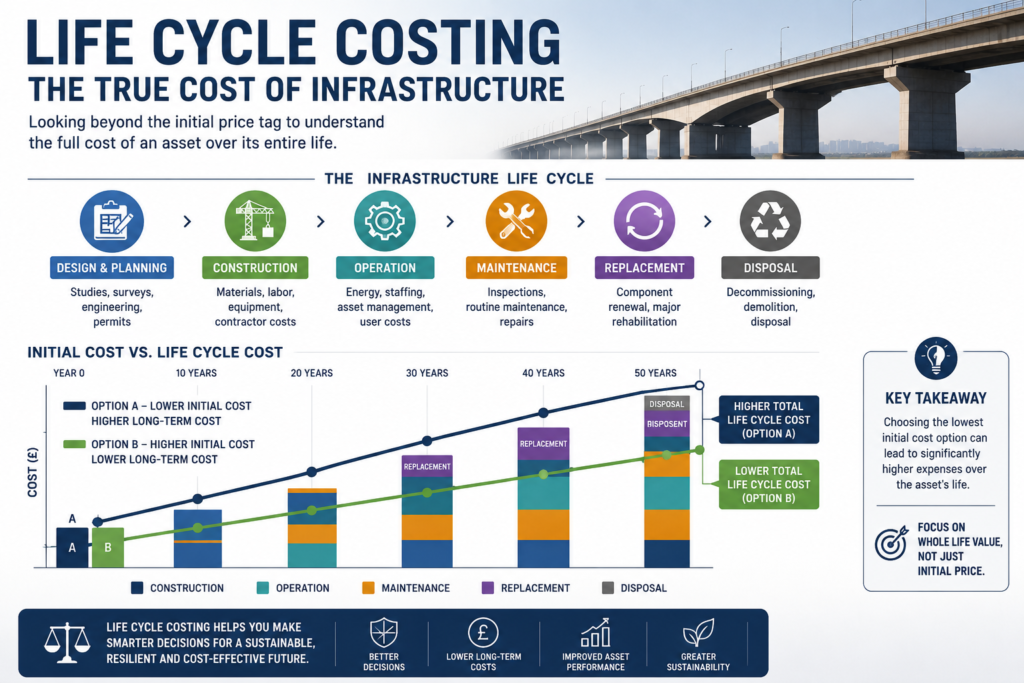
Life cycle costing is a method for comparing the costs associated with an asset or investment over a defined period.
Instead of considering only the initial capital cost, an LCC assessment may include:
- planning, design and construction costs;
- inspection and routine maintenance;
- operation, energy and staffing;
- repair and rehabilitation;
- replacement of components;
- disruption and user impacts;
- residual value;
- decommissioning and disposal.
Because many of these costs occur years or decades into the future, they are normally converted to present value using an agreed-upon discount rate.
The objective is not simply to calculate the largest possible collection of future costs. It is to compare credible alternatives consistently.
A bridge design with a higher construction cost, for example, may require fewer interventions and cause less disruption during its operational life. A cheaper pavement solution may need resurfacing more frequently. A low-cost mechanical system may consume more energy and require earlier replacement.
LCC provides a framework for testing whether the apparently expensive option is actually the more economical one over the selected study period.
That is the theory, at least.
Why First-Cost Thinking Is So Attractive
Infrastructure organisations frequently say they support whole-life value. Their investment decisions, however, can still be dominated by the initial capital budget.
This is understandable. Capital cost is visible, immediate and relatively easy to report. Future maintenance expenditure belongs to another financial period, another budget and, occasionally, another generation of management.
A £5 million saving today is easy to place on a presentation slide.
An uncertain £12 million of maintenance and disruption avoided between years 25 and 50 is less cooperative.
This creates a familiar problem: the option with the lowest entry price can appear to offer the best value, even when it merely transfers costs into the future.
Life cycle costing challenges that behaviour by asking a less convenient question:
Cheap for whom, and over what period?
A design may reduce the delivery team’s capital expenditure while increasing the asset operator’s maintenance burden. It may reduce the cost paid by the client while increasing delay and disruption for users. It may meet the current budget while creating a series of expensive interventions that have not yet appeared in anybody’s business plan.
Without a life-cycle perspective, these costs do not disappear. They are simply waiting offstage.
Life Cycle Costing Does Not Extend Asset Life by Itself
This is where some descriptions of LCC become misleading.
Life Cycle Costing is not an engineering treatment, a protective coating, or a maintenance regime. It cannot physically extend the life of a bridge, tunnel or substation.
What it can do is help decision-makers recognise the financial consequences of choices that influence durability, maintainability, reliability and resilience.
An LCC assessment may support investment in:
- more durable materials;
- better access for inspection and maintenance;
- modular or replaceable components;
- greater system redundancy;
- improved corrosion protection;
- lower-energy equipment;
- designs that reduce future closures or possessions.
Those interventions may extend service life or reduce maintenance requirements. But the improvement comes from the design and asset-management decisions, not from the calculation itself.
The spreadsheet does not save the bridge. The decisions informed by it might.
What Makes a Life Cycle Cost Assessment Credible?
A credible LCC model needs more than a collection of future costs and an impressive-looking chart.
First, the alternatives must provide comparable performance. It is meaningless to declare one option cheaper if it delivers a different capacity, reliability, service life or level of resilience.
Second, the analysis period must be appropriate. A short study period can unfairly favour an option whose major replacement cost falls just beyond the cut-off date. Select 30 years instead of 35, and a conveniently timed renewal may vanish from the model.
Third, future interventions must be based on realistic asset strategies. Maintenance cannot be represented as an unexplained annual percentage simply because no intervention schedule has been developed.
Fourth, the economic assumptions must be consistent. Discount rates, inflation treatment, price bases, escalation and residual values can materially change the result. Mixing real and nominal values is an especially efficient way of producing a very precise answer to the wrong question.
Finally, the model must explain its assumptions, exclusions and data sources. An LCC output without this information is not an assurance. It is an undocumented opinion with decimal places.

The Problem of Predicting the Future
All cost estimates contain uncertainty. Life Cycle Costing gives that uncertainty more time to develop.
A construction estimate may need to anticipate market conditions over the next five years. An LCC model may be making assumptions about energy prices, maintenance performance, asset usage and technology several decades ahead.
Small changes can become significant.
Consider some of the assumptions commonly found in a life-cycle model:
- How long will a component actually last?
- How frequently will inspections be required?
- Will maintenance access remain available?
- What will labour, energy, and materials cost?
- Will demand increase or decline?
- Will environmental standards change?
- Will replacement technology still be available?
- Will the asset operate in the conditions originally assumed?
The further the model travels into the future, the less credible a single deterministic answer becomes.
This does not make LCC pointless. It means the model should be used to explore uncertainty rather than conceal it.
Sensitivity analysis can show which assumptions have the greatest influence on the result. Scenario analysis can compare different maintenance, demand or climate outcomes. Switching values can indicate how far a variable must change before the preferred option is no longer the best value.
For major or particularly uncertain investments, probabilistic analysis may provide a range of possible outcomes rather than a single number pretending to know what will happen in 2075.
Climate Resilience Cannot Be a Footnote.
Historic deterioration data remains valuable, but future operating conditions may not resemble the past.
Higher temperatures, flooding, coastal erosion, extreme rainfall and changing ground conditions can affect maintenance frequency, asset performance and service life. An intervention schedule based entirely on historic averages may therefore understate future expenditure.
The solution is not to invent an arbitrary “climate percentage” and add it to the total.
Climate-related assumptions should be linked to credible scenarios and translated into specific consequences. These might include more frequent drainage maintenance, accelerated material degradation, additional inspections, protection works or earlier replacement.
Where the evidence is uncertain, the model should present alternative scenarios and explain the uncertainty openly.
An assumption does not become reliable merely because it has been entered into Excel.
Five Questions Every LCC Review Should Ask
Before accepting a life-cycle cost conclusion, reviewers should ask five straightforward questions.
1. Are we comparing like with like?
Each alternative should satisfy the required performance, safety, capacity and service criteria.
2. Is the study period fair?
The selected period should capture meaningful maintenance and replacement cycles without conveniently excluding major future costs.
3. Where did the intervention assumptions come from?
Asset data, maintenance strategies, supplier information, engineering judgement or comparable evidence should support them.
4. Which variables control the answer?
Sensitivity testing should identify whether the decision depends on asset life, intervention frequency, energy prices, discount rates or another key assumption.
5. Would the conclusion survive a less optimistic scenario?
If a modest change reverses the preferred option, the recommendation should not be presented as certain.
These questions are not designed to destroy the model. They are designed to prevent the model from acquiring authority it has not earned.
Is LCC the Holy Grail of Infrastructure Longevity?
No.
Life Cycle Costing cannot guarantee durability, predict the future or rescue a poorly defined option appraisal. It will not compensate for missing asset data, unrealistic maintenance assumptions or a study period selected to favour a preferred solution.
It can, however, expose the long-term consequences of decisions that would otherwise be judged almost entirely on capital cost.
Used properly, LCC helps project teams:
- Compare alternative designs consistently;
- identify long-term cost drivers;
- understand the trade-off between capital and operating expenditure;
- test the affordability of future maintenance;
- examine the financial value of durability and resilience;
- make assumptions and uncertainty visible.
The most important point is that LCC remains a decision-support tool. It does not decide on behalf of the client, engineer, operator or asset manager.
The option with the lowest calculated life-cycle cost may still be rejected because of safety, deliverability, resilience, environmental impact, funding constraints or wider social value. Equally, the option with the lowest initial cost should not automatically be described as best value simply because its future consequences sit outside the current budget.
Key Takeaways
Life Cycle Costing provides a broader view of infrastructure expenditure than capital cost alone.
Its usefulness depends on the quality of the scope, asset data, intervention schedules, and economic assumptions that support it.
Future costs should be tested through sensitivity, scenario or probabilistic analysis rather than presented as certain.
LCC does not directly extend asset life. It helps decision-makers understand the cost consequences of choices that may improve durability, maintainability and resilience.
Most importantly, the output is evidence for a decision, not the decision itself.
Infrastructure does not need a mythical fountain of youth. It needs better information, transparent assumptions and organisations willing to consider what happens after the opening ceremony.
For cost estimators, that means looking beyond the number required for the next approval gate and asking whether today’s savings are simply tomorrow’s maintenance problem.
Not quite magic, admittedly.
But considerably more useful.