

Rollercoaster Budget: The Ups, Downs, and Loop-the-Loops of Infrastructure Spending
Infrastructure Budget Overruns: Why Project Costs Rise and Why Not Every Increase Is an Overrun
Fasten your seatbelts. The infrastructure budget rarely travels in a straight line.
It climbs during business-case development, pauses while everyone admires the approved funding envelope, and then drops when surveys, design, procurement and delivery introduce themselves. Somewhere along the route comes a utilities corkscrew, an inflation loop, a change-order bend and an unexpected schedule tunnel.
Unlike a theme-park ride, nobody queues willingly for this experience. At the end, there is usually a revised forecast and an estimator being asked why the number has ‘changed again’.
Infrastructure budgets usually don’t become unstable because arithmetic stopped working. They move because the project is moving: scope develops, assumptions expire, risks materialise, markets change, and decisions arrive late.
What looked like a firm number may have been an early estimate in a suit, pretending to be a commitment.
The short answer: infrastructure project costs rise for several different reasons. Some are genuine overruns. Others are approved scope changes, improved information, inflation, risk events, schedule effects or corrections to an incomplete earlier estimate. Good cost control separates these causes instead of placing all of them in one bucket marked ‘overrun’.
Estimate, Budget, Forecast and Outturn Are Not the Same Thing
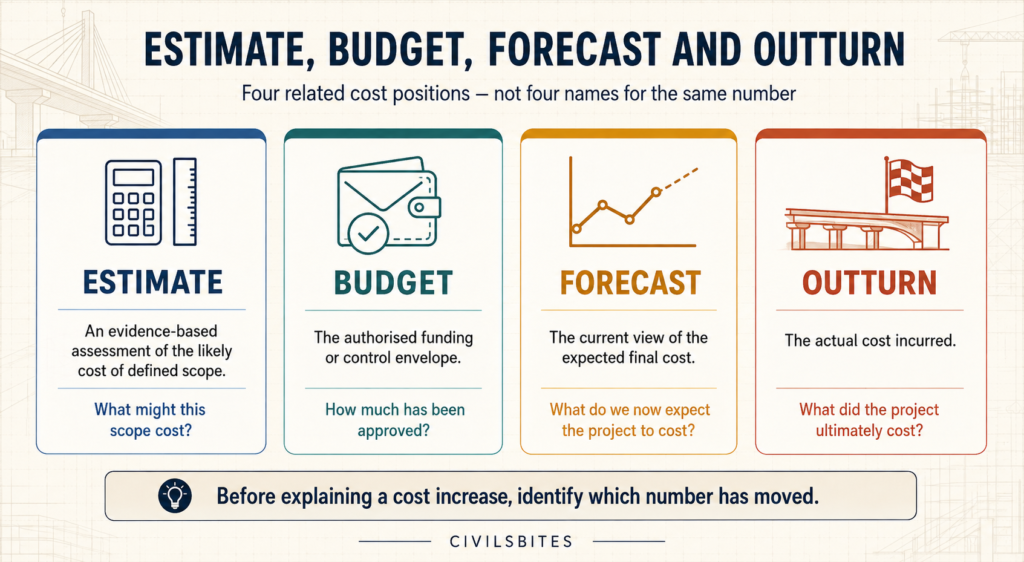
Before asking why a cost has increased, it helps to identify which number has moved.
| Term | What it means | The question it answers |
|---|---|---|
| Estimate | An evidence-based assessment of the likely cost of defined scope at a stated date and level of maturity | What might this scope cost, given what we currently know? |
| Budget | The authorised funding or control envelope against which the project is governed | How much has been approved or made available? |
| Forecast | The project’s current view of the expected final cost | What do we now expect the project to cost? |
| Outturn | The actual cost incurred, expressed on a clearly stated price basis | What did the project ultimately cost? |
These figures are related, but they are not interchangeable.
A budget can remain fixed while the forecast rises above it. An estimate can change before a budget has even been approved. The final outturn can sit below the latest forecast but above the original early estimate. A project can also remain within its authorised budget while the underlying cost of individual packages changes.
Calling every movement an ‘overrun’ hides these distinctions.
When Is a Cost Increase Really an Overrun?
An overrun is meaningful only when the comparison has a defined baseline.
The original and current figures should cover comparable scope, use a consistent price basis and be measured against an approved point of reference. If the project has changed, the comparison must show that change.
Consider an early estimate of £100 million at 2024 prices. It excludes land, major utility diversions and client-side delivery costs. Two years later, the project forecast is £135 million in outturn prices and includes all three.
The difference is £35 million, but that does not prove that the same project became 35 per cent more expensive. Part of the movement may be inflation. Part may be a scope that was previously excluded. Part may be an approved enhancement. Part may be genuine cost pressure.
Until those components are reconciled, ’35 per cent overrun’ is a headline, not an analysis.
The Initial Climb: When Everything Still Looks Affordable
Every rollercoaster begins with a reassuring climb.
At the earliest stage, the concept is clean, the drawings are limited, and the delivery narrative is wonderfully uncomplicated. The route appears clear. Ground conditions are described as ‘typical’. Existing utilities are assumed to be somewhere else. Access looks straightforward. Stakeholders are supportive—at least the three consulted.
The estimate may be based on high-level quantities, parametric relationships, benchmarks from previous schemes and several provisional assumptions. That can be entirely appropriate for option selection or an early business case.
The problem is not that an early estimate contains uncertainty. That is unavoidable.
The problem begins when the uncertainty disappears from the conversation, but the number remains.
The UK government’s Cost Estimating Guidance states that an estimate should be presented as a range reflecting risk and uncertainty, with the range reducing as the project develops. The government’s 2026 study of governance and budgeting for mega projects makes the same practical point: projects should begin development with broad cost and schedule ranges, and a fixed capital budget should follow only when a robust estimate supports the final investment decision.
That does not make early estimates weak. It makes them fit the decision.
Trouble starts when an option-comparison estimate is promoted into a delivery budget without buying the surveys, design, market evidence and risk analysis needed to support that promotion.
The First Drop: Scope and Design Maturity
Then the project learns more.
Surveys identify unsuitable ground. Utilities appear exactly where the foundations need to go. Environmental commitments become design requirements. Temporary works grow from a footnote into a major package. Access restrictions affect productivity. The ‘minor interface’ turns out to involve three asset owners and a complex possession or outage strategy.
None of this automatically means that the original estimator failed. It may mean that the project now knows more than it did before.
As design develops:
- quantities become clearer;
- construction methods become more realistic;
- exclusions are challenged;
- interfaces are allocated;
- operational constraints are understood;
- procurement packaging becomes credible
- and provisional assumptions are tested against evidence.
This process can increase or decrease the estimate. Either direction should be explainable.
A project should distinguish between the following:
- a genuine increase in the price of delivering the same scope;
- scope discovery—work that was always required but not previously understood;
- scope development—the progressive definition of an agreed requirement;
- correction of an omission, error or unsupported assumption;
- and the addition or enhancement of scope after the original estimate.
These are not interchangeable. Placing them in one large bucket labelled ‘cost growth’ destroys the audit trail and teaches the organisation very little.
For a deeper explanation of how estimate context should be recorded, see The Basis of Estimate Is Not Administrative Decoration.
The Cost-Movement Map
A useful cost report should classify movement by cause, not merely announce a new total.
| Movement category | What it represents | How it should be treated |
| Estimate refinement | Better quantities, rates or methodology for the same defined scope | Reconcile to the previous basis and explain why the evidence changed |
| Scope development | Greater definition of an existing requirement | Show the relationship between design maturity and earlier allowances |
| Approved scope change | A new, removed or altered requirement | Process through change control and update scope, cost, schedule and risk baselines |
| Correction | An error, omission, duplication or inconsistent assumption | Report transparently; do not disguise it as design development |
| Escalation | The effect of price movement between the base date and expected expenditure | State indices, dates, methodology and residual inflation risk |
| Market movement | Tender appetite, labour scarcity, supplier capacity, commodities or commercial conditions | Support with market engagement and current evidence |
| Risk materialisation | An uncertain event or condition that has occurred | Transfer the effect into the forecast and record any contingency drawdown |
| Schedule effect | Prolongation, acceleration, resequencing or movement into a different market window | Link the cost impact to an updated, credible program. |
| Efficiency or value engineering | A deliberate reduction in cost without unapproved loss of required outcomes | Record the decision, evidence and any transfer of risk or whole-life cost |
This classification prevents the project from rewriting its history each time the forecast changes.
It also exposes a common reporting trick: claiming that an estimate remains unchanged because cost increases have been offset by removing scope, consuming contingency or assuming future savings that have not yet been secured.
The total may look stable. The project is not necessarily in the same position.
The Change-Order Corkscrew
When the track appears to level out, the changes arrive.
Some are unavoidable. Safety requirements evolve, site conditions demand a different solution, or a stakeholder identifies a legitimate operational need. Others are less heroic: late preferences, unresolved decisions or the rediscovery of excluded scope.
Each change carries more than its visible direct cost. It may affect:
- design and assurance;
- procurement and supplier commitments;
- temporary works and logistics;
- construction sequencing;
- access, possessions or outages;
- testing and commissioning;
- risk allocation;
- and the completion date.
After contract award, disruption, prolongation and commercial consequences may outweigh the cost of the changed physical work.
This is why change control cannot be reduced to updating a spreadsheet after a meeting. It must establish what changed, why it changed, who authorised it, which assumptions and baselines are affected, and the full cost, schedule, risk, and benefit consequences.
The government’s Teal Book guidance on change control says its purpose is to ensure only beneficial or necessary changes to a baseline are implemented.
Without that discipline, the budget becomes a passenger rather than a control mechanism.
See also Scope Creep: When the Project Changes but the Budget Doesn’t.
The Inflation Loop: Base Date, Current Price and Outturn Price
Inflation is one of the most familiar villains in infrastructure budgeting, but it is often treated too casually.
Published indices can bring historical costs to a common price base. That helps with comparison, but it does not automatically predict what a particular project will experience.
Labour availability, energy prices, commodities, manufacturing capacity, regional demand, exchange rates, procurement timing and tender appetite can all affect the amount eventually paid.
Long programmes are especially exposed because work packages are procured and delivered at different times. If the following are conflated, apparently similar figures may represent entirely different points on the ride:
- the estimate’s base date;
- current prices;
- forecast escalation;
- nominal or outturn prices;
- inflation included in contracts;
- and residual inflation risk.
Government cost-estimating guidance requires the estimate to have a stated base date and the mechanism used to move between historical, current or future prices to be clearly evidenced.
Escalation therefore needs explicit dates, suitable indices, transparent calculations and sensitivity or scenario testing. It should not be an invisible formula hidden in the final tab of a workbook maintained by the only person who understands it.
The Supply-Chain Corkscrew
Even a well-developed estimate can be thrown sideways by the market.
Infrastructure programmes compete for specialist labour, plant, materials, manufacturing slots and competent suppliers. A technically feasible programme may be commercially difficult because several projects require the same resources at the same time.
The cheapest theoretical construction method is not always the most deliverable one. Historic benchmarks may need adjustment where the following is true:
- the supply chain is constrained;
- the geography or access is difficult;
- the programme is compressed;
- package sizes discourage competition;
- contractual terms transfer risks that suppliers cannot efficiently manage;
- or the benchmark comes from a different market cycle.
Market engagement is part of cost intelligence. A model developed without understanding how the work will be bought and delivered may elegantly describe an imaginary project.
Benchmarking still matters, but comparisons must be normalised for scope, time, location, procurement route, specification, complexity and risk allocation. A £/m², £/km or £/asset metric looks reassuringly scientific; it is useful only when the denominator and the underlying scope are genuinely comparable.
The Schedule-and-Cost Helix
Time and cost are not separate rides.
A delay can extend design resources, project management, supervision, accommodation, plant hire, traffic management and temporary works. It can move procurement into an unfavourable market window or cause supplier quotations to expire.
Acceleration also carries a cost. Extra shifts, parallel working, premium logistics and reduced productivity may be required to recover time.
Yet schedules are sometimes developed independently from estimates, as though the programme can slip while the budget remains politely stationary.
The Teal Book guidance on planning says plans should use robust, evidence-based estimates aligned with the schedule and account for risk, contingency, and optimism bias.
A credible estimate therefore needs a credible schedule. Procurement dates, construction sequence, expenditure timing and risk exposure all matter.
Cash flow is not simply the total cost divided by the number of project years. It is the financial expression of the delivery strategy.
Contingency Is a Safety Bar, Not a Magic Wand
Every rollercoaster has restraints. Infrastructure projects have contingency—or at least they should.
But contingency is frequently misunderstood. It is not:
- spare money for additional scope;
- a home for known costs that nobody wanted to show;
- a substitute for incomplete estimating;
- an automatic ten or twenty per cent added by custom;
- or an amount that can be removed merely to make the approval paper more comfortable.
A useful contingency assessment should be connected to risk and uncertainty within the defined scope. It should reflect scope maturity, data quality, interfaces, delivery strategy and the organisation’s chosen confidence level. It should also be reviewed as the project changes.
Most importantly, contingency cannot repair a weak base estimate.
Adding 20 per cent to a weak model produces a weak model with a larger total.
The 2026 government review of mega-project budgeting emphasises that contingency should be risk-based, funded, and clear about who holds it and how to access it. That is governance, not simply arithmetic.
For a fuller treatment, read Contingency: The Magic Word Everyone Misuses.
Contingency Is Not Optimism Bias
The terms are sometimes combined, but they serve different purposes.
HM Treasury’s Green Book 2026 requires appraisals to adjust explicitly for optimism bias: the established tendency for appraisals to be over-optimistic about costs, durations and benefits.
That appraisal adjustment does not replace project-level estimating, risk analysis or contingency. Nor should optimism bias be quietly consumed to fund additional scope.
The project should state which allowance is being used, for what purpose, at which confidence level and under whose control.
How to Make the Ride Explainable
Infrastructure budgets will never be perfectly flat. The objective is not to eliminate movement but to make it visible, controlled and proportionate.
1. Define the estimate’s purpose
An estimate prepared to compare options is not automatically suitable for approving a construction budget. State the decision it supports, the level of scope maturity and the estimating method used.
2. Maintain a live Basis of Estimate
The basis of estimate should record scope, boundaries, assumptions, exclusions, quantities, rates, sources, price base, programme, procurement strategy, risk treatment and approvals. It should develop with the estimate—not be reconstructed after the number has already been presented.
3. Use ranges while knowledge is limited
A wide range is not a defect when the project is immature. It communicates uncertainty. The range should narrow because evidence improves, not because governance demands a more comfortable answer.
4. Align scope, cost, schedule and risk
The work breakdown structure, cost breakdown structure, programme, risk register and change register should describe the same project. Misalignment creates gaps, duplication, and untraceable movement.
5. Keep a cost-movement register
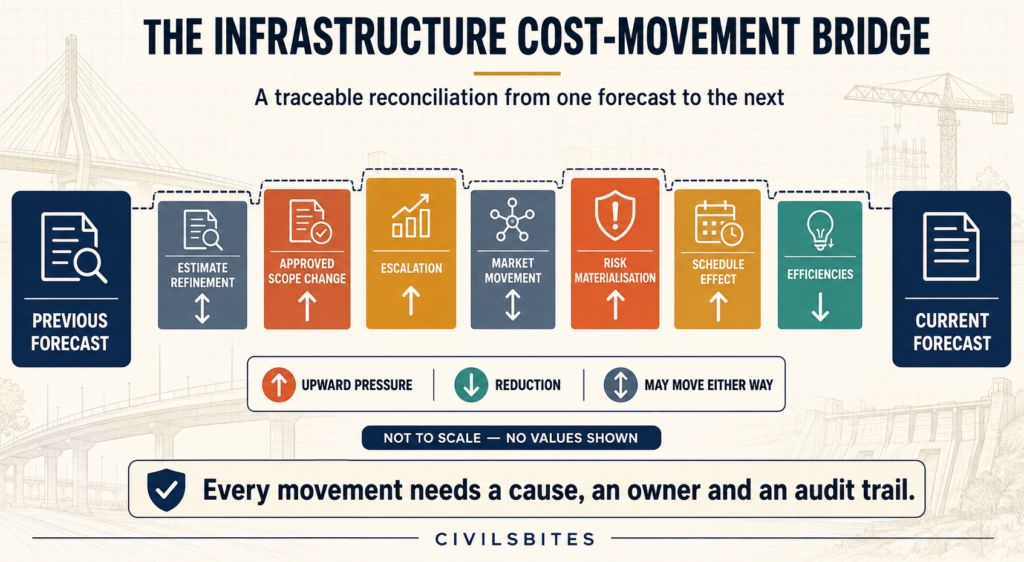
Every material movement should have a category, cause, owner, approval status, and a link to the affected scope, assumption, risk, or schedule activity. This creates a bridge from the previous forecast to the current one.
6. Separate the components of cost
Decision-makers should be able to distinguish the following:
- base cost;
- estimating uncertainty;
- project risk and contingency;
- escalation;
- approved change;
- and any management reserve or sponsor-held provision.
Different organisations may use different terminology, but the definitions and boundaries must be explicit.
7. Test the market and the delivery strategy
Challenge rates and benchmarks against current market evidence, procurement packaging, capacity constraints, geography, and contractual risk allocation.
8. Assure the logic, not only the arithmetic
An independent review should test scope completeness, assumptions, quantities, methodology, benchmarks, risk, schedule and commercial strategy. A spreadsheet can be arithmetically correct while the project it describes is fundamentally incomplete.
That is why cost confidence should arrive before the project obituary.
What a Useful Budget Report Should Show
A budget update should not simply announce that the forecast has risen by £20 million. It should provide a traceable bridge.
At minimum, decision-makers should be able to see:
- the approved baseline and its price basis;
- the previous forecast;
- approved scope changes;
- scope or design development;
- estimate corrections;
- actual and forecast escalation;
- market and procurement movement;
- realised risks and contingency drawdown;
- schedule-related impacts;
- efficiencies or value engineering;
- the current forecast and its confidence range;
- remaining contingency and who controls it;
- the decisions or evidence needed before the next update.
The Teal Book guidance on reporting requires costs to be considered against the plan for the period, year and whole life of the work. The principle is simple: reporting should support control, not merely record surprise.
Without a movement bridge, every change looks like an estimating failure. With one, leaders can distinguish genuine cost pressure from better information, changed requirements and deliberate investment decisions.
Budget reporting should not be designed to defend yesterday’s number. It should help the project make a better decision today.
Key Takeaways
- A changing estimate is not automatically evidence of failure; an unexplained estimate is.
- Estimate, budget, forecast and outturn describe different cost positions.
- An overrun needs a defined, comparable baseline—not merely an earlier, lower number.
- Report scope discovery, scope development, approved change, escalation, market movement, risk, and schedule effects separately.
- Early estimates should communicate ranges and uncertainty appropriate to the decision they support.
- Contingency must be risk-based, governed and distinct from new scope or optimism bias.
- Scope, cost, schedule, risk and change control must tell the same story.
- A cost-movement bridge is more useful than a dramatic headline about the latest increase.
Frequently Asked Questions
Why do infrastructure project costs rise?
The main causes are developing scope and design, approved changes, inflation, market conditions, risk events, schedule movement and corrections to earlier assumptions or omissions. More than one cause will often operate at the same time.
Is every increase in an estimate a cost overrun?
No. Measure a genuine overrun against a defined, comparable baseline. If scope, price basis, timing, or included cost categories have changed, reconcile those movements first.
Why are early infrastructure estimates often presented as ranges?
Early projects contain unresolved scope, design, programme, market and risk information. A range communicates the resulting uncertainty. It should narrow as evidence and definition improve.
Can contingency cover scope changes?
Contingency is normally intended for uncertainty within a defined scope. Assess and authorise new or enhanced scope through change control, with the necessary funding and baseline updates.
Final Stop: Cost Confidence, Not Budget Theatre
The rollercoaster metaphor feels familiar because project costs rise, fall and occasionally appear to defy gravity. The ride becomes dangerous when uncertainty is hidden, scope movement is poorly controlled, and early estimates are presented as promises.
A changing estimate is not automatically evidence of failure.
An unexplained estimate is.
Projects need fewer theatrical declarations that ‘the budget is fixed’ and more disciplined conversations about what the budget includes, what it excludes, how mature the estimate is, what could move it and who owns the decisions behind it.
So fasten the safety bar, keep the Basis of Estimate nearby and resist treating every early number as the final fare.
Infrastructure delivery will always contain twists and turns. Good cost planning ensures that, even when the project enters a loop-the-loop, everyone knows why—and nobody has to pretend it was a straight track all along.
Sources and Further Reading
AACE International: Guide to Cost Estimate Classification Systems
HM Treasury: The Green Book 2026
HM Treasury: Green Book supplementary guidance on optimism bias
UK Government: Cost Estimating Guidance
Government Project Delivery: The Teal Book—Planning
Government Project Delivery: The Teal Book—Reporting
Government Project Delivery: The Teal Book—Change Control
HM Treasury: Governance and Budgeting Arrangements for Mega Projects, 2026
Carlo Gabriele Borri MCIOB AMICE
Infrastructure cost planning and estimating professional with experience across transport, energy and major programmes. Carlo created CivilsBites to make infrastructure knowledge clearer, more visual and easier to use.
Disclaimer: The views expressed are personal and do not necessarily represent those of any employer or client. Content is provided for general educational purposes and does not constitute professional advice.