The Most Expensive Wildlife You’ll Never See
The Elusive’ Unforeseen Circumstances in Infrastructure Development
Infrastructure development is a noble pursuit… filled with unforeseen circumstances. We build bridges, railways, substations, tunnels and water networks so that society can function efficiently, safely and—on particularly ambitious days—on time.
Unforeseen circumstances in infrastructure projects are frequently blamed for cost increases, delays and programme disruption. Yet many of these supposedly rare creatures are not truly unforeseen. They are foreseeable risks that were insufficiently investigated, quantified or communicated before the budget was approved.
But every infrastructure project also appears to contain its own protected ecosystem.
Somewhere between the concept design, the business case and the first excavator arriving on site, a collection of mysterious creatures begins to emerge.
They live beneath incomplete surveys. They nest inside assumptions. They migrate through risk registers. And when the final account arrives, they are invariably described as unforeseen circumstances.
These are the most expensive animals you will never see.
They are rarely photographed, never tagged and almost impossible to find during estimate reviews. Yet once construction begins, they suddenly appear everywhere—usually accompanied by an early warning notice, a compensation event or a request for additional funding.
The Wildlife Behind Unforeseen Infrastructure Costs
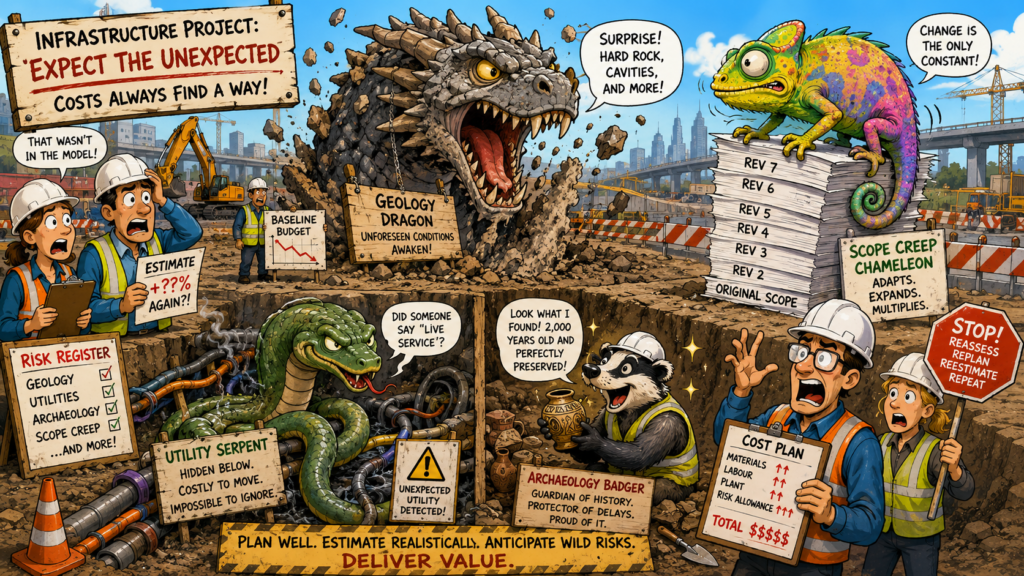
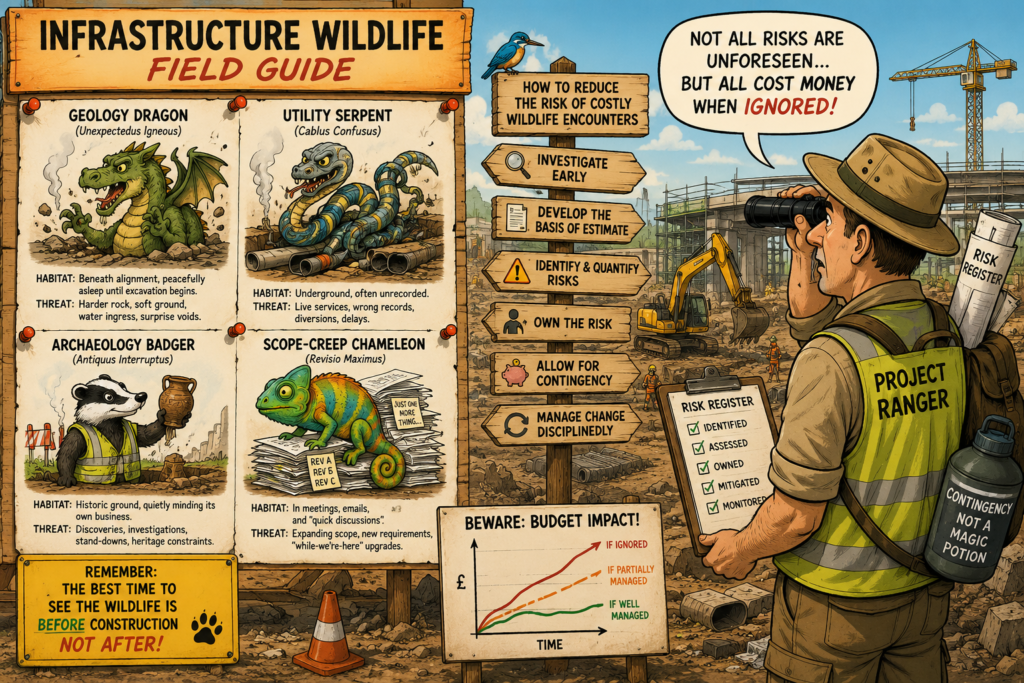
The most famous inhabitant is the Sleeping Dragon of Geology.
It rests peacefully below the proposed alignment until piling, excavation or tunnelling begins. Then it wakes up disguised as harder rock, softer ground, contaminated soil, perched groundwater, undocumented foundations or an inconveniently mobile water table.
The dragon is normally declared “impossible to anticipate”, even when the ground investigation consisted of three boreholes, an old desktop study and the optimistic belief that conditions between them would behave themselves.
Next comes the Subterranean Utility Serpent.
This creature is shown on statutory undertakers’ drawings as a thin, reassuring line. On site, it becomes a tangled nest of live cables, abandoned ducts, unrecorded connections, and pipes installed several metres away from where the records suggested they would be.
It is especially attracted to city centres, railway corridors and any project that priced diversions using the phrase “allowance only”.
Then there is the Archaeological Badger of Programme Delay.
Unlike ordinary wildlife, it does not need to be alive to stop the works. A wall, burial, vessel, foundation, or fragment of industrial heritage can trigger an investigation, protection, redesign, and months of careful coordination.
The discovery itself may genuinely be unexpected. The possibility of discovering something on a historically sensitive site is usually not.
Overhead circles the Migratory Flock of Environmental Requirements.
Planning conditions, protected species, seasonal working restrictions, noise limits, water-quality controls, carbon commitments and habitat obligations descend upon the project. Sometimes requirements genuinely change. More often, they were visible in the planning environment but were treated as someone else’s problem until “someone else” submitted the cost.
Finally, we meet the most adaptable species of all: the Scope-Creep Chameleon.
It begins life as a minor clarification. It then changes colour and becomes an operational requirement, a stakeholder commitment, a safety enhancement or a “small improvement while we are here”.
By the time it reaches the cost report, it has blended seamlessly into the baseline, and nobody can remember who invited it.
Unforeseen—or Merely Unexamined?
Here lies the uncomfortable truth: not every surprise is an unforeseen circumstance.
Some events are genuinely difficult to predict. No investigation can remove all uncertainty. Infrastructure is delivered within complex physical, commercial, environmental and political systems. Unknown conditions exist, regulations change, and external events occur.
But there is a crucial difference between:
- something that could not reasonably have been foreseen;
- something foreseeable but uncertain;
- something that was identified but not quantified;
- something that was excluded from the estimate;
- and something that nobody investigated because the programme wanted a number by Friday.
These categories are often collapsed into one convenient phrase once costs begin to rise.
“Unforeseen” then becomes less a description of the event and more a defensive strategy. It protects the original estimate, preserves the illusion that the baseline was sound and allows every later increase to be presented as an attack by nature rather than a failure of project development.
The phrase should therefore trigger questions, not close them.
What information was available at the time? What surveys had been completed? What assumptions were recorded? Was the risk included in the register? Was its probability assessed? Was an allowance included? Was the estimate appropriate for the design’s maturity? Who accepted the residual exposure?
Until those questions are answered, the creature has not been identified.
It has merely been given a dramatic name.
What Counts as an Unforeseen Circumstance in Infrastructure Projects? And Contingency Is Not a Wildlife Feeding Programme
The traditional response is to add contingency.
This is sensible—until contingency becomes a flat percentage sprinkled over an immature estimate, making uncertainty disappear.
Ten per cent is added because ten per cent feels responsible. Twenty per cent is added because the project looks difficult. The resulting total is then announced as a “robust budget”, even though nobody can explain which risks the money is intended to cover.
A contingency allowance should be linked to identified uncertainty and risk. It should reflect the maturity of the scope, the quality of information, the delivery strategy and the range of credible outcomes.
It should not be used to conceal unresolved decisions or to compensate for the absence of a proper basis for the estimate.
Nor should contingency be confused with optimism bias.
UK appraisal guidance recognises that project teams systematically underestimate costs and durations and overestimate benefits. Optimism bias is an adjustment for that tendency at the appraisal stage, particularly where project-specific evidence remains weak.
It is not the same as a quantified project risk allowance, nor is it a substitute for developing the design.
Adding several loosely defined uplifts does not create confidence.
It can simply create a larger number with the same weak foundations.
How to Keep the Creatures Behind the Fence
The first defence is proportionate investigation.
Ground investigations, utility surveys, ecological studies, asset condition assessments, and stakeholder engagement cost money.
So does discovering during construction that they should have been done earlier.
The objective is not to investigate everything indefinitely. It is to reduce uncertainties that could materially affect the design, cost, or programme before irreversible commitments are made.
The second defence is a visible basis of estimate.
An estimate should state what has been priced and what has not, the source and date of quantities, the design maturity, productivity assumptions, exclusions, qualifications, market basis, escalation treatment, and risk methodology.
If an estimate cannot explain its own boundaries, every animal in the forest can later claim residency.
The third defence is risk ownership.
A risk register is not a decorative annex. Each material risk needs an owner, a response, a timeframe and a relationship to cost and schedule.
“Contractor risk” is not the owner.
“To be confirmed” is not a mitigation.
And transferring a risk contractually does not make it physically disappear. It merely changes who prices it, manages it or eventually argues about it.
The fourth defence is range-based thinking.
Early estimates should not pretend to possess late-stage precision. A range, supported by explicit uncertainty and probability, communicates more than a single deterministic number wearing a hard hat.
Decision-makers should understand what drives the difference between the lower and upper outcomes—and what must happen before that range can credibly narrow.
Finally, maintain change discipline.
When scope, standards, interfaces or assumptions change, the baseline should not be quietly rewritten.
Record the decision, identify the cost and programme effect, and preserve the audit trail. Otherwise, yesterday’s scope change becomes tomorrow’s unforeseen circumstance.
The Final Sighting
Infrastructure will always contain uncertainty. The goal is not to eradicate every surprise or claim supernatural foresight.
The goal is to stop treating foreseeable exposure as an exotic animal that wandered onto the project without warning.
The most dangerous creature is not the hidden rock formation, the protected species or the undocumented cable.
It is the comforting belief that a poorly developed estimate becomes reliable simply because it has been approved.
So, the next time an “unforeseen circumstance” appears in a cost report, do not immediately reach for the contingency reserve.
Ask for its habitat, its migration history and the last time it was seen in the risk register.
You may discover that the rare beast was living in the assumptions all along.
And if the project team insists that nobody could have predicted it, check the original estimate.
There is probably a caveat on page 47.